Most visitors to Japan drink tea without ever thinking about where it comes from. Green tea appears at every meal, in every vending machine, in every konbini — so ubiquitous that it becomes background noise. But in the hills of Saga Prefecture, in a small onsen town called Ureshino, tea is not background. It is the reason the town exists.
Ureshino has been producing tea since the 1440s, making it one of the oldest continuous tea-growing regions in Japan. What makes it unusual is not just its age but its method: while nearly all Japanese tea today is steamed, Ureshino's signature style is kamairi-cha — pan-fired tea, roasted in an iron wok over direct heat. This method arrived from China through the nearby port of Nagasaki and has survived here for almost six centuries, even as the rest of Japan moved on.
Kamairi-cha vs steamed tea
The difference between pan-fired and steamed tea is fundamental. When tea leaves are harvested, enzymes within the leaf begin to oxidize immediately — the same process that turns a cut apple brown. Japanese tea processing halts this oxidation quickly to preserve the green color and fresh flavor. The question is how.
Steaming (the standard method, used for sencha, gyokuro, and matcha) produces a deeply vegetal, almost marine flavor with a vivid jade-green liquor. This is the taste most people associate with Japanese green tea.
Pan-firing takes a different path. The leaves are tossed in a heated iron pan (kama), which stops oxidation through dry heat rather than steam. The result is a tea with a lighter, more golden color in the cup and a distinctive roasted, slightly nutty aroma. The flavor is rounder, less astringent, with a sweetness that unfolds over multiple infusions. If steamed sencha is a sharp line, kamairi-cha is a soft curve.
"Kamairi-cha accounts for less than five percent of all tea produced in Japan. It survives in Ureshino not because of nostalgia, but because the people here believe it produces a better cup."
— Ureshino Tea Master
A 600-year lineage
Tea arrived in Ureshino during the Muromachi period, likely in the 1440s. Chinese merchants and monks traveling through Nagasaki brought both the seeds and the pan-firing technique. At that time, all Japanese tea was processed this way. The shift to steaming came later, in the 18th century, when Nagatani Soen in Uji developed the steaming method that produced the bright green sencha that would come to define Japanese tea.
Most regions adopted the new method. Ureshino, geographically isolated in the mountains of northwest Kyushu, kept firing. The reasons were partly practical — the iron pans and techniques were already deeply embedded in local knowledge — and partly cultural. Ureshino's proximity to Nagasaki meant a continued connection to Chinese tea culture, where pan-firing remained the norm. The town chose to refine what it already did well rather than follow the national trend.
This stubbornness produced something valuable: a living tradition of a nearly extinct technique, practiced by farmers whose families have been firing tea for ten or fifteen generations.
The tea farms
Ureshino's tea farms are not the vast, manicured fields you see in photographs of Shizuoka or Kagoshima. They are smaller, often carved into hillsides, tended by families rather than corporations. The volcanic soil of Saga Prefecture — rich in minerals from the region's geological history — gives Ureshino-cha a distinctive terroir. The humid climate, with warm days and cool mountain nights, creates ideal conditions for amino acid development in the leaf, which translates to umami in the cup.
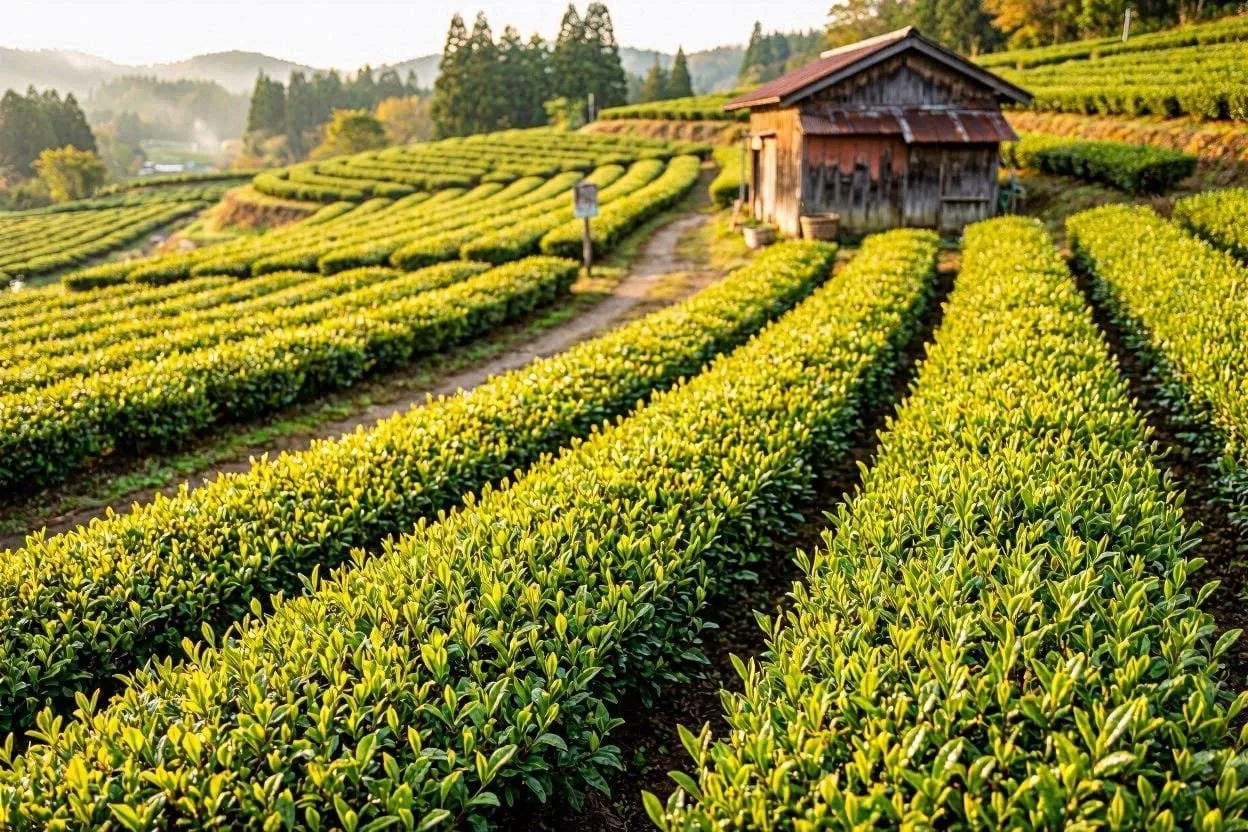
Several farms in the area welcome visitors, particularly during the spring harvest season. The first flush (ichibancha) is picked in late April to early May and is considered the highest quality — the leaves are tender, rich in theanine, and carry the concentrated sweetness of winter dormancy. The second flush follows in June, and a third in autumn.
At the farms, you can watch the entire process: picking, withering, firing in the iron pan, rolling by hand, and drying. The smell of the firing room — green leaves hitting hot iron, releasing a cloud of sweet, grassy steam — is something that stays with you.
Where to taste
The town of Ureshino itself is small enough to walk in an afternoon, and tea is everywhere. A few places stand out for anyone wanting to go deeper than a vending machine bottle.
Ureshino Tea Exchange Center (嘉野茶交流館): The most accessible introduction. Staff walk you through a tasting of local varieties — kamairi-cha, tamaryokucha (a curled green tea unique to the region), and seasonal specialties. You can compare the same leaf processed by steaming versus pan-firing side by side, which is the fastest way to understand the difference.
Local tea shops: Several family-run shops along the main street sell direct from the farm. Look for shops that let you taste before buying — most will brew a cup of whatever they recommend that season. Prices are remarkably reasonable compared to tea in Tokyo or Kyoto, because you are buying at the source.
Ryokan tea service: At Swallow Base's partner ryokans, the welcome tea served on arrival is always Ureshino-cha. Pay attention to it. The okami-san chooses the variety and the brewing temperature deliberately, and the cup you drink in the first five minutes of your stay is often the best introduction to the region's character.
Tea-picking seasons
If your stay overlaps with the harvest, the experience changes entirely. During the first flush in late April and May, the entire town smells of tea. Farmers work from dawn, and the firing sheds operate through the afternoon. Some farms offer hands-on picking experiences where you learn to identify the ideal "two leaves and a bud" pluck that produces the best tea.
"During the first flush, the entire town smells of tea. You cannot walk a block without catching the scent of leaves meeting hot iron."
The autumn harvest in September and October produces bancha — a more robust, everyday tea made from mature leaves. It lacks the delicacy of first-flush kamairi-cha but has its own appeal: a heartier, more toasted flavor that pairs well with the cooler weather and heavier autumn meals.
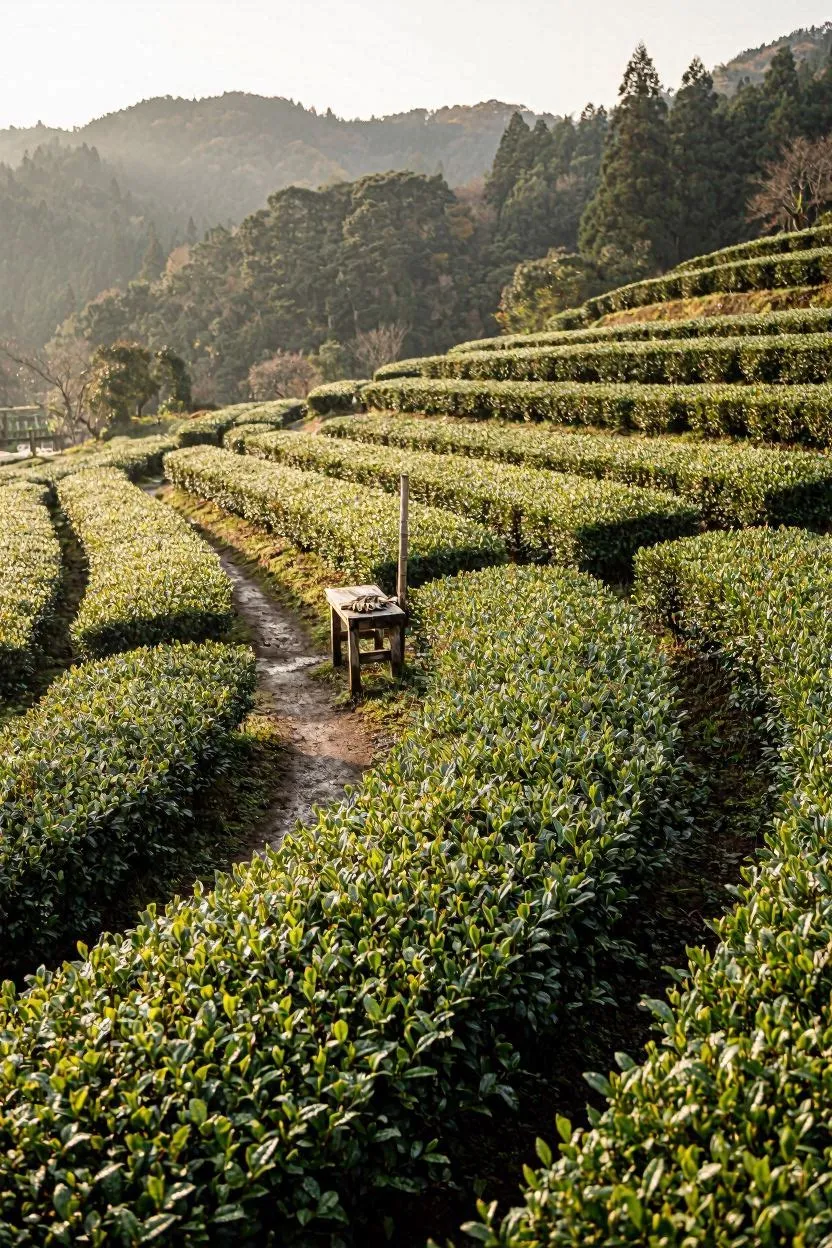
Between harvests, the fields are quiet but still beautiful — geometric rows of tea bushes following the contours of the hills, shifting from deep green in summer to a softer olive in winter. The landscape itself is part of the tea culture. You cannot separate the drink from the place that produces it, and Ureshino makes no effort to try.