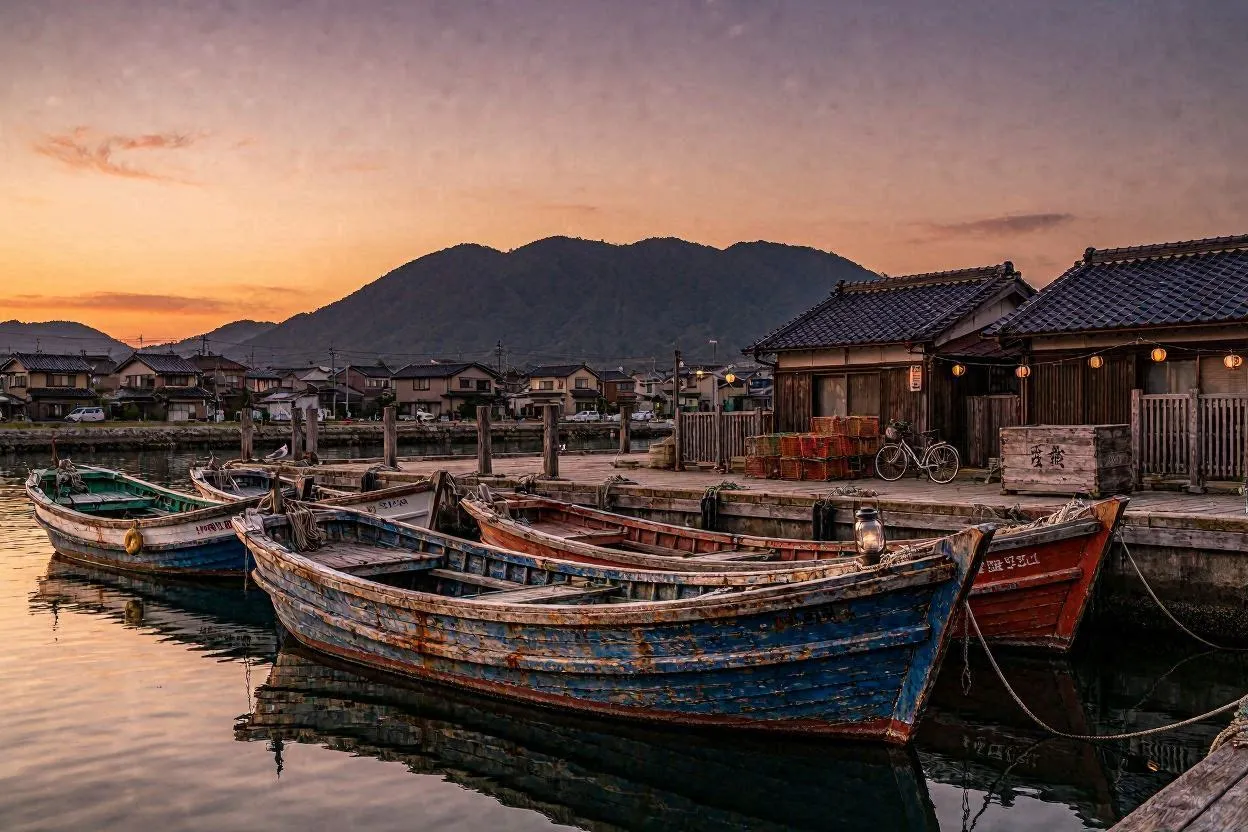
On a gray morning in the spring of 1854, seven American warships anchored in the harbor at Shimoda, a small fishing town at the southern tip of the Izu Peninsula. The ships were painted black. Their steam engines belched coal smoke across the bay. Local fishermen had never seen anything like them. Neither had the Tokugawa government in Edo, which is precisely why they were there.
Commodore Matthew C. Perry had arrived to finish what he started a year earlier: forcing Japan to open its ports to American trade after more than two centuries of self-imposed isolation. The country he was prying open had been closed since 1635, when the Tokugawa shogunate enacted sakoku — the "locked country" policy that restricted virtually all foreign contact to a single Dutch trading post on the artificial island of Dejima in Nagasaki harbor.
What happened at Shimoda in the weeks and months that followed would end Japan's isolation, begin its transformation into a modern nation, and leave marks on the town that are still visible today. For anyone staying on the Izu Peninsula — as Swallow Base guests do — this history is not an abstraction. It is the ground beneath your feet.
The black ships
Perry's first visit to Japan came in July 1853, when his squadron of four vessels — two steam-powered, two sailing ships — entered Edo Bay (now Tokyo Bay). The Japanese called them kurofune (黒船, "black ships") for their dark hulls and the smoke that trailed behind them. Perry delivered a letter from President Fillmore demanding the opening of Japanese ports, then departed, promising to return for an answer.
He returned in February 1854 with a larger fleet: seven ships and over 1,600 men. Negotiations took place over several weeks, not in Edo but at Kanagawa (near modern-day Yokohama). On March 31, 1854, the Treaty of Kanagawa was signed, opening two ports to American ships: Hakodate in the north and Shimoda in the south.
Shimoda was chosen deliberately. It was remote — far from Edo, tucked behind the mountains of the Izu Peninsula — where foreign ships could resupply without contaminating the capital with Western influence. The Tokugawa government hoped to contain what it could not refuse. In retrospect, containment was never possible.
"Shimoda was chosen because it was far from everything that mattered. That remoteness, which the shogunate saw as a buffer, is what preserved the town. It is also what makes it worth visiting now."
— On Shimoda's Geography
Townsend Harris and the first consulate
In 1856, Townsend Harris arrived in Shimoda as the first American Consul General to Japan. He established the American consulate at Gyokusen-ji, a Zen Buddhist temple on a hill overlooking the harbor. Harris's position was difficult: he was a lone diplomat in a country that did not want him there, living in a temple whose monks resented his presence, negotiating with officials who had been ordered to delay and obstruct.
Despite this, Harris secured the Harris Treaty of 1858, which opened additional ports and established formal diplomatic and trade relations between the United States and Japan. This treaty became the template for similar agreements with Britain, France, the Netherlands, and Russia — the so-called "unequal treaties" that would shape Japan's foreign relations for decades.
Gyokusen-ji still stands. You can visit the temple, see the room where Harris lived and worked, and read the plaques that describe his tenure. The view from the temple grounds down to the harbor has not changed much since 1856. Standing there, it is easy to understand both the loneliness of his position and the strategic beauty of Shimoda's location.
Shimoda today
Modern Shimoda is a quiet coastal town of about 20,000 people. It has the unhurried feel of a place that was once important and is now content to be beautiful. The tourism that does arrive is mostly domestic — Japanese families visiting the beaches in summer, couples coming for the onsen in winter.
Perry Road
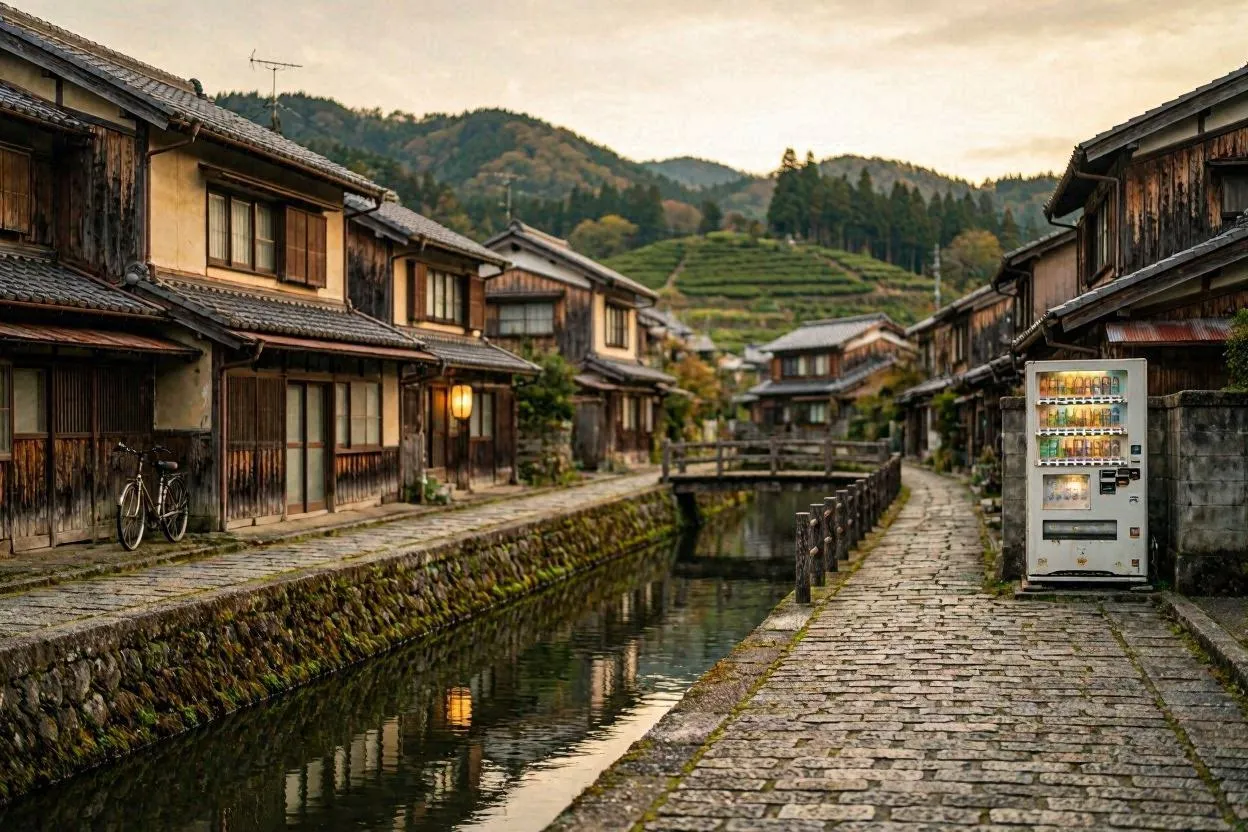
Perry Road is a short canal-side street named for the commodore, lined with willow trees and converted storehouses. The old stone and stucco buildings now house cafes, antique shops, and galleries. The street follows the route that Perry's men walked from the harbor into town. On a weekday morning, you might be the only person there, which gives it a contemplative quality that a more famous historical site would never permit.
Ryosen-ji
Ryosen-ji is the temple where the Treaty of Shimoda was signed in 1854 — a supplementary agreement to the Treaty of Kanagawa that formalized Shimoda's role as an open port. The temple's museum displays documents, maps, and woodblock prints from the period, including contemporary Japanese depictions of Perry and his crew. The Japanese artists had never seen Western faces, and their renderings — long noses, enormous eyes, bizarre postures — are both historically fascinating and unintentionally funny.
Namako-kabe architecture
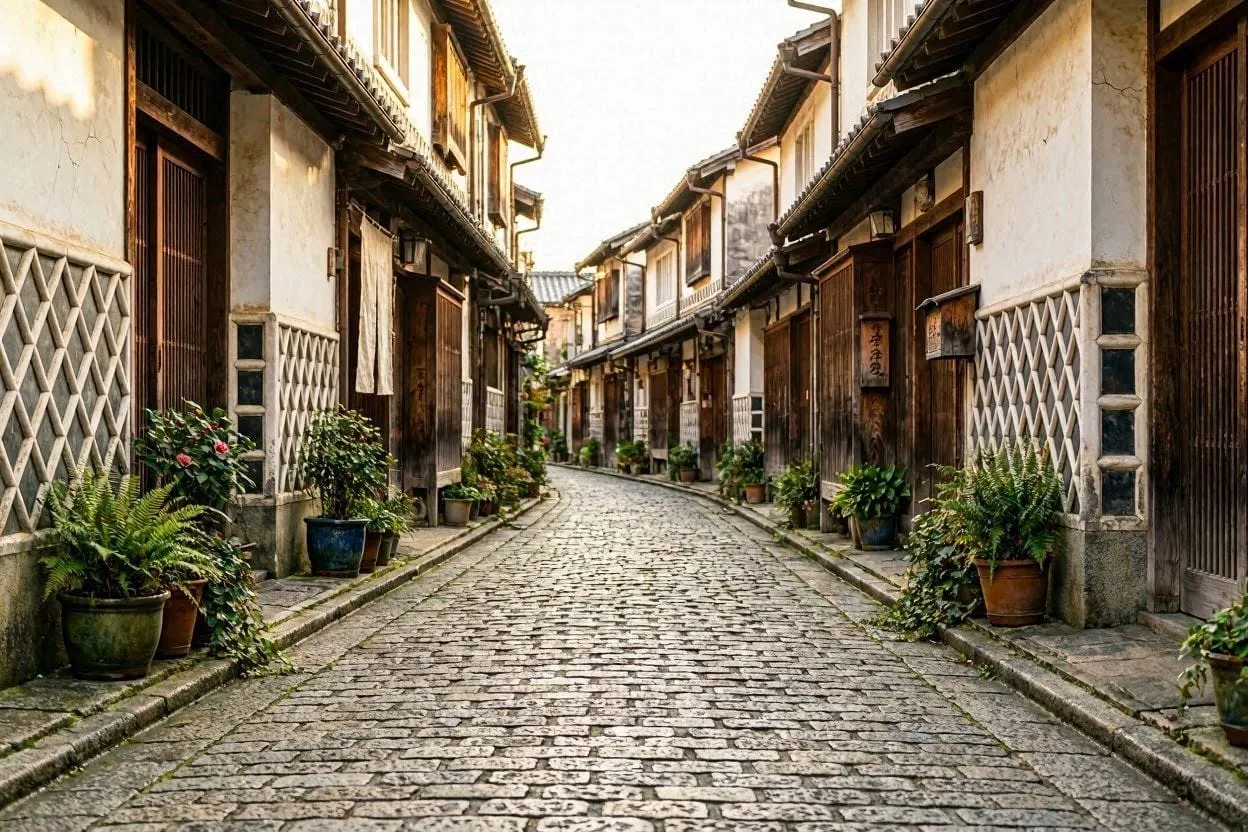
Throughout Shimoda's older neighborhoods, you will notice a distinctive wall pattern: diamond-shaped tiles of dark gray plaster outlined by raised white lines. This is namako-kabe (海鼠壁, literally "sea cucumber wall"), a style of fireproof construction developed during the Edo period. The tiles are set in a grid and joined with thick ridges of white plaster, creating a pattern that resembles the skin of a sea cucumber.
Namako-kabe served a practical purpose: the plaster coating resisted fire, and the raised ridges channeled rainwater away from the wall surface. But the visual effect is striking — graphic, geometric, and immediately recognizable. Several streets in Shimoda's old quarter retain these walls, and walking among them gives a vivid sense of what the town looked like when Perry's ships appeared in the harbor.
The beaches
The Izu Peninsula's coastline is rugged and dramatic, shaped by volcanic geology and the constant work of the Pacific. Shimoda's beaches — Shirahama, Sotoura, Kisami Ohama — are among the best in the Kanto region. The water is clear, the sand is pale, and the crowds thin out almost entirely outside of summer weekends. In the shoulder months of May and October, you can have a cove to yourself.
For remote workers, the combination is compelling: a town with genuine historical depth, natural beauty, excellent onsen, and the quiet that comes from being at the end of a peninsula rather than the center of a city. Shimoda does not market itself aggressively. It does not need to. The harbor, the temples, the volcanic cliffs, and the memory of the black ships are enough.
The weight of the place
What makes Shimoda compelling for a longer stay is not any single attraction but the accumulated weight of its history. You are working from a town that was, for a brief and pivotal moment, the point of contact between a 250-year-old closed civilization and the outside world. The consequences of that contact — the Meiji Restoration, Japan's rapid modernization, the world wars, the economic miracle, the Japan that exists today — all trace back, in part, to what happened in this harbor.
"In Japan, the deepest things rarely announce themselves."
That history is not performed or packaged. It is simply present in the temples, the streets, the walls, and the view from the headland where a lookout once scanned the horizon for foreign sails. When you close your laptop in the evening and walk to the harbor, you walk the same route that fishermen, diplomats, and revolutionaries have walked before you. The town does not make a fuss about it. In Japan, the deepest things rarely announce themselves.